plate rolling machine structure

How the internal structure of the sheet metal rolling machine is designed?

How the internal structure of the sheet metal rolling machine is designed?


Do you know how the internal structure of the sheet metal rolling machine is designed? There are many types of rolling machines, how many parts do they have in their internal structure, and how are these parts designed?

One

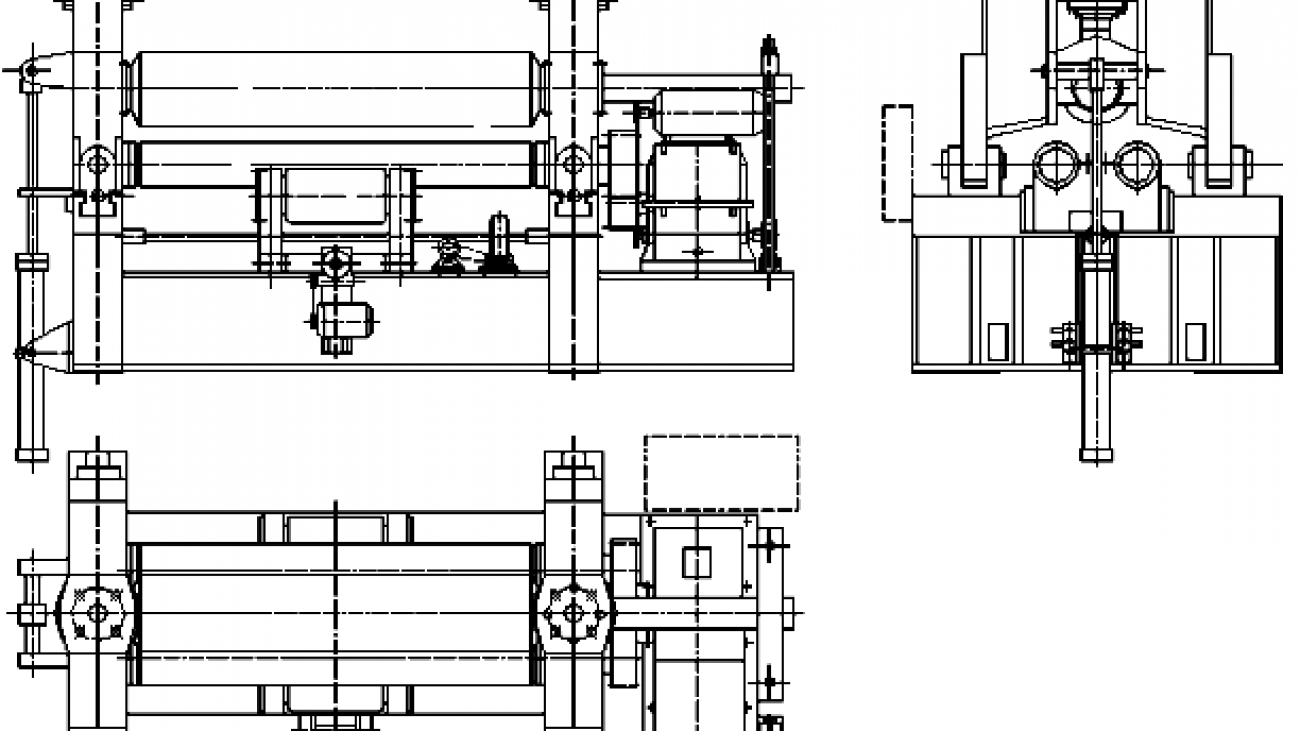
Take symmetrically adjusted three-roll sheet metal rolling machine as an example. The two lower rollers are active rollers with fixed positions, and the upper roller is a movable roller that can move up and down. With the help of the clutch, the upper roller can be adjusted to the parallel or inclined position with respect to the lower roller to meet the needs of rolling round or conical workpieces. Three rollers are installed on the left and right frames to form the main body of the machine. The transmission system is all arranged on the right side of the right frame, and the frame and the transmission part are arranged on the integral welded base to form the main body of the machine. The electric control console is located in front of the machine. In order to indicate the up-and-down displacement of the upper roller, pointers and scales are set on the right frame and the bearing. In order to facilitate the removal of the cylindrical workpiece from the upper roller, a turning bearing is provided at the left end of the upper roller, and a tilting adjustment structure is provided at the right end.


The positive and negative rotation of the lower roller, the lifting, tilting, and leveling of the upper roller are controlled by electrical appliances, the disengagement and closing of the flip bearing of the discharge, the position adjustment of the tilting adjustment mechanism, and the clutch clutch are all manually operated.

Therefore, the three-roller sheet metal rolling machine with this structure, because the position of the two lower rollers is fixed and is always symmetrical to the upper roller, the remaining straight side of the end of the workpiece that is directly rolled by it is long, so you need to use special tools or Other equipment pre-bends the end to make up for this deficiency.

Because of its simple structure, reliable work, and easy maintenance, it is widely used in other production of medium plate tubes.

Two

The two lower rollers of the sheet metal rolling machine are the driving rollers, which are transmitted by the main motor through the three-stage transmission pair of the arc gear reducer with a ratio of 62.2 to the first-stage open gear pair supported by the lower roller, so that the lower roller The design rotation speed is obtained and constitutes the main transmission system of the machine. There is a brake in the main drive system to achieve rapid braking.

The lifting movement of the upper roller is decelerated by the auxiliary motor through the secondary transmission pair of the auxiliary circular arc gear reducer with a ratio of 12, which drives the worm gear pair installed in the frame to rotate, and the wire sleeve embedded in the wheel rotates to force the connection to the upper roller.The lifting screw rod moves linearly, forming the auxiliary system of the machine. The adjustment of the relative position of the two ends of the upper roller with respect to the lower roller is realized by separately lifting the lifting screw Hodder at the left end after disengaging the clutch on the worm shaft.

The upper roller of the sheet metal rolling machine is the active roller. The main motor drives the upper roller to work through the main reducer and coupling. The function of the lower roller is to provide a certain upward force to clamp the rolled steel plate together with the upper roller to make Sufficient friction is generated between the upper roller and the coiled steel plate, which can drive the steel plate to move when the upper roller rotates. The two side rollers are used to form the required curvature of the roll, so that the sheet can achieve the required purpose.

Three

In the four-roller sheet metal rolling machine we designed, we used the main motor through the main reducer and coupling to drive the upper roll to rotate. For the movement of the lower roller, we put a hydraulic cylinder on each end of the lower roller, and the hydraulic oil in the hydraulic cylinder acts on the piston so that the lower roller can move up and down, so that the steel plate can be clamped and controlled by the hydraulic system. The lifting of the roller and the two hydraulic cylinders keep rising synchronously during the ascending process. There are two side rollers on both sides of the lower roller. The two side rollers are respectively driven by two motors through two single-stage reducers and couplings; the two motors can be controlled separately or simultaneously. The two side rollers It can be tilted along the guide rails of the frame and driven by a worm gear and a screw nut.

NC press brake

Purchase knowledge of hydraulic bending machine|CNC bending machine

Purchase knowledge of hydraulic bending machine|CNC bending machine


There are 6 points need to considerate when you buy a hydraulic bending machine.


  • Artifact

The first important thing to consider is the parts you want to produce. The point is to buy a machine that can complete the processing task with the shortest workbench and the smallest tonnage.

Carefully consider the material grade and the maximum processing thickness and length. If most of the work is low carbon steel with a thickness of 16 gauge and a maximum length of 10 feet, then the free bending force does not need to be greater than 50 tons. However, if you are engaged in a large number of bottomed die forming, perhaps a 150-ton machine tool should be considered. Assuming that the thickest material is 1/4 inch, 10 feet free bending requires 165 tons, and bottomed die bending (correction bending) requires at least 600 tons. If most of the workpieces are 5 feet or shorter, the tonnage is almost halved, which greatly reduces the purchase cost. The length of the part is very important for determining the specifications of the new machine.


  • Torsion

Under the same load, the deflection of the worktable and sliding block of the 10-foot machine is 4 times that of the 5-foot machine. This means that shorter machines require fewer shim adjustments to produce qualified parts. Reduced shim adjustment and shortened preparation time. Material grade is also a key factor. Compared with low-carbon steel, the load required for stainless steel is usually increased by about 50%, while most grades of soft aluminum are reduced by about 50%. You can get the machine’s tonnage table from the bending machine manufacturer at any time. The table shows the estimated tonnage required per foot in different thicknesses and different materials.


  • The bending radius of the part

When using free bending, the bending radius is 0.156 times of the die opening distance. During the free bending process, the opening distance of the die should be 8 times the thickness of the metal material. For example, when forming mild steel with an opening distance of 1/2 inch, the bending radius of the part is about 0.078 inches. If the bending radius is almost as small as the material thickness, a bottomed die must be formed. However, the pressure required for forming a bottomed die is about 4 times greater than that of free bending.

If the bending radius is less than the thickness of the material, a punch with a front-end fillet radius smaller than the thickness of the material must be used, and the imprint bending method must be used. In this way, 10 times the pressure of free bending is required.

As far as free bending is concerned, punch and die are processed at 85° or less. When using this set of molds, pay attention to the gap between the punch and the die at the bottom of the stroke, and the excessive bending that is sufficient to compensate for the springback and keep the material at about 90°.

Generally, the springback angle of the free bending die on the new bending machine is ≤2°, and the bending radius is equal to 0.156 times the opening distance of the die.

For the bending of bottomed concave mold, the mold angle is generally 86 ~ 90°. At the bottom of the stroke, there should be a gap slightly larger than the thickness of the material between the male and female molds. The forming angle is improved because the bottomed die has a larger bending tonnage (about 4 times that of free bending), which reduces the stress that usually causes springback in the bending radius.

The imprint bending is the same as the bending of the bottomed die, except that the front end of the punch is processed to the required bending radius, and the gap between the punch and the die at the bottom of the stroke is smaller than the material thickness. Since enough pressure (approximately 10 times of free bending) is applied to force the front end of the punch to contact the material, springback is basically avoided.

In order to select the lowest tonnage specification, it is best to plan for a bending radius larger than the material thickness and use the free bending method as much as possible. When the bending radius is large, it often does not affect the quality of the part and its future use.


  • Precision

Bending accuracy requirements are a factor that needs to be carefully considered. It is this factor that determines whether you need to consider a CNC bending machine or a manual bending machine. If the bending accuracy requires ±1° and it cannot be changed, you must focus on the CNC machine.

The repeatability of the slider of the CNC bending machine is ±0.0004 inches, and the precise angle of forming must use such precision and a good mold. The repeatability of the slide block of the manual bending machine is ±0.002 inches, and the deviation of ±2~3° is generally produced under the condition of using a suitable mold. In addition, the CNC bending machine is prepared for rapid mold assembly. When you need to bend many small batches of parts, this is an indisputable reason for consideration.


  • Mould

Even if you have shelves full of molds, don’t assume that these molds are suitable for the newly purchased machine. The wear of each mold must be checked by measuring the length from the front end of the punch to the shoulder and the length between the shoulder of the female mold.
For conventional molds, the deviation per foot should be about ±0.001 inches, and the total length deviation should not exceed ±0.005 inches. As for the precision grinding mold, the accuracy per foot should be ±0.0004 inches, and the total accuracy should not be greater than ±0.002 inches. It is best to use fine grinding molds for hydraulic bending machines, and conventional molds for manual bending machines.


  • Side length of bending part

Assuming that it is bent 90° along a 5×10-foot mild steel plate, the bending machine must apply an additional 7.5 tons of pressure to lift the steel plate, and the operator must prepare for the 280-pound straight-edge drop. It may require several strong workers or even a crane to manufacture this part. Operators of bending machines often need to bend long-side parts without realizing how hard their work is.

Nowadays, there is a kind of supporting device suitable for workshops engaged in this kind of work. This kind of device can be improved according to the needs of new and old machines. With this device, only one person is required to form long-side parts.


W67K-100T3200 NC PRESS BRAKE

MB8-100T3200 Electric CNC Press Brake,Sheet Metal Bending Machine for Sale

MB8-100T3200 Electric CNC Press Brake,Sheet Metal Bending Machine for Sale

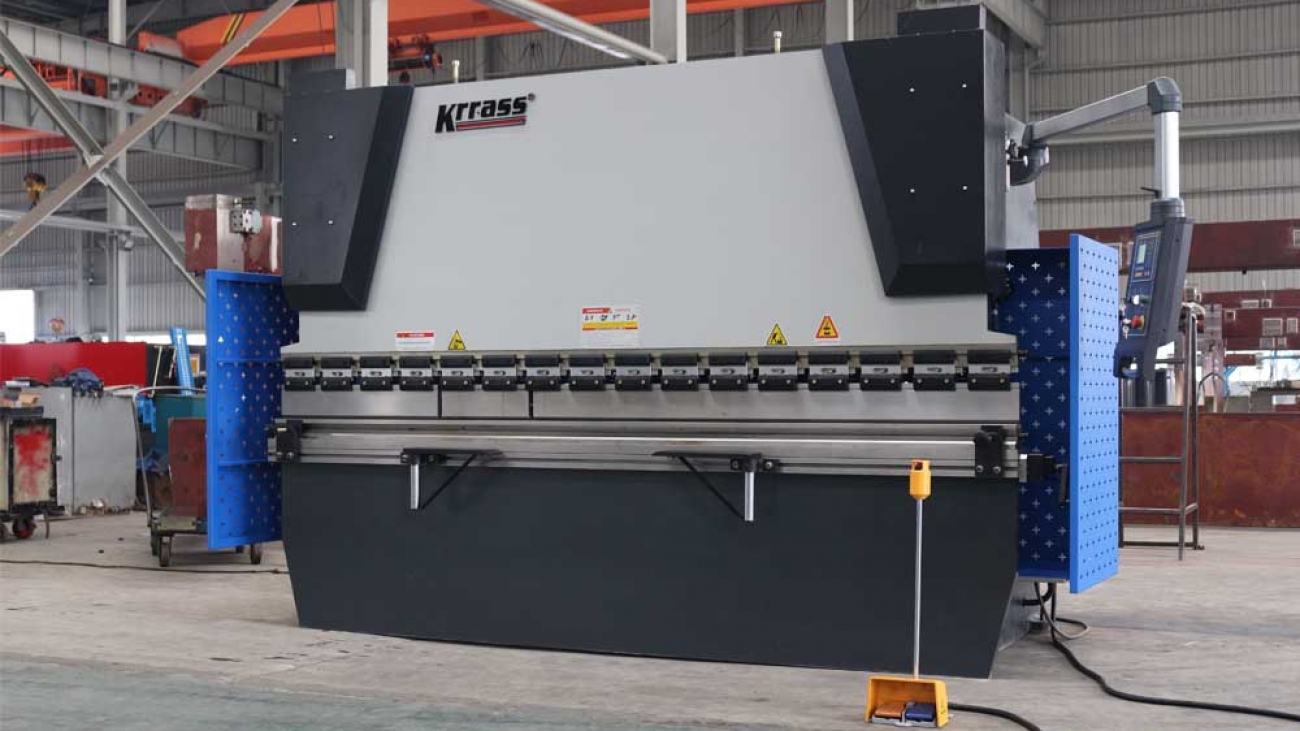
The main structure and performance of the machine:

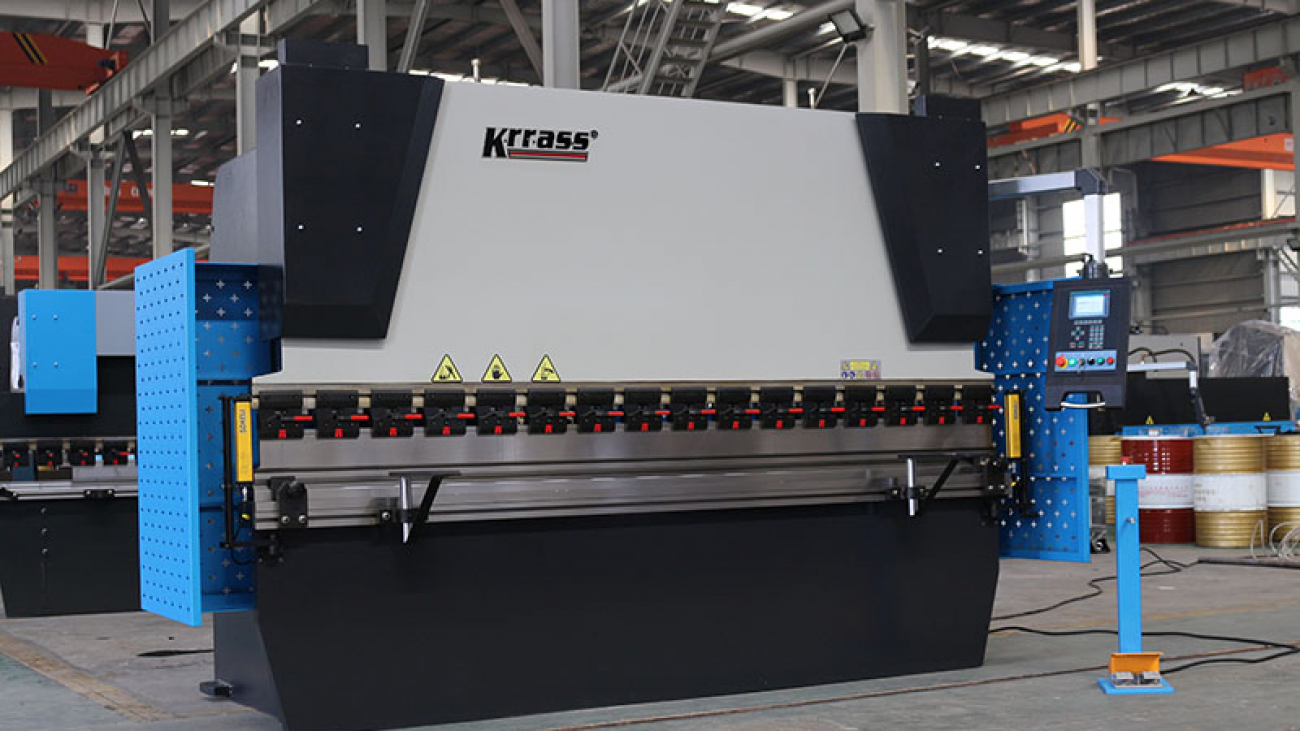
The machine is designed and manufactured using the latest technology from KRRASS, CHINA, ensuring the strength, rigidity and safety of the machine. Machine tool shape is simple and beautiful, exquisite workmanship, mechanical processing, assembly of components, etc. are all fine work. The machine adopts the whole high-quality steel plate welding structure, the frame is thick and rigid, the machine surface sprayed with imported rust-proof primer and finish to make the machine last as long as new. Rack and upper work slider using imported large-scale CNC floor boring milling and other precision machining to ensure the location of each mounting surface requirements.

cnc press brake

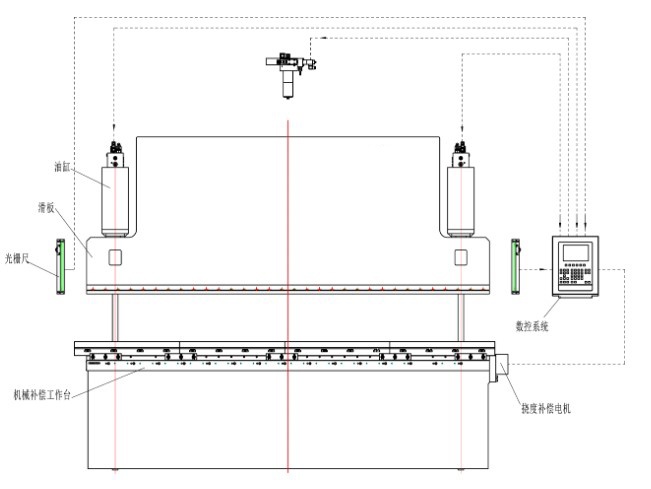
The machine is mainly composed of rack, skateboard, rear bezel system, slider and synchronous control device, mold, control system, etc.:

(1) Rack part: This part is a frame structure, composed of work bench, left and right side plate, join beam, mechanical compensation device, etc. The use of steel plate overall welding, good rigidity, high strength, has a good ability to resist distortion and deformation, and through the surface projectile treatment and other processes to eliminate internal stress, to ensure the overall accuracy of the machine tool lasting stability;

(2) Upper skateboard part: left and right cylinder with bolts and frame fastening joint, cylinder piston rod and slider using sphericic pad and screw joint, the structure enables the slider to withstand bias can improve the working status of the piston rod and piston rod and slider binding performance; The slider and the frame are sub-joined by a rectangular rail with self-lubricating function, and a grating ruler with a measurement accuracy of 0.005mm is installed on the C-plate on both sides of the rack to detect and feedback the simultaneous motion of the two cylinders in order to control the travel position of the slider.

(3) Mold and clamping device: the mold consists of two parts of the upper mold and the lower mold, using the overall quenching, durable. The upper mold is mounted on the slider, and is fixed by the fast press plate clamping device, and the lower die is in the form of a comodulation mode, which is convenient and fast to change the mold, reducing labor intensity and improving production efficiency.

(4) Front support bracket: This part is standard part, installed on the front of the work station. When used, the lift holder can be manually moved to the appropriate position for fastening according to the length of the work, and the carrier can be adjusted horizontally and vertically.

(5) Special structure of the throat deformation compensation device: each side of the machine installed a grating ruler, used to measure and feedback the precise distance between the slider and the lower work station. The grating ruler is connected with the workbench by C-frame, which eliminates the effect of rack throat deformation on the position of the slider, the position data of the slider is fed back to the CNC system when the slider is running, and the operation of the proportional servo valve is controlled by the CNC system output signal, which controls the movement of two sets of proportional servo valves respectively, so that the two cylinders maintain precise synchronization.

This structure enables the machine to be anti-biased and effectively prevents non-standard work items from colliding with the grating ruler.

(6) Rear stop device: the use of Belgium’s latest design accurate and stable rear stop device, servo motor drive ball screw, with high speed, positioning accuracy characteristics;

(7) Mechanical compensation device: when bending the plate material, the upper skateboard will inevitably produce scratching deformation, so that the bend angle of the work piece is small at both ends, the middle of the large state. This machine is equipped with compensation iron, and through the CNC system control, so that the lower work table produces pre-convex compensation on the skateboard deformation, the angle change of the work piece is controlled in the tolerance range, to ensure high-quality bend accuracy.

(8) Cantilever system: more ergonomic cantilever system, set a reasonable rotation radius, more flexible, more easy to operate.

The oil pump adopts the German VOITH Voith high-performance internal meshing gear pump, with high volume efficiency, low pressure fluctuation, low noise, light weight, wide viscosity range and good oil absorption characteristics.

Product Parameters

No.NameUnitValve
1Nominal PressureKN400
2Bending Lengthmm1500
3Column Spacingmm1100
4Slider Strokemm1500
5Maximum Opening Heightmm430
6Throat Depthmm320
7Worktable Heightmm800
8Maximum speed of slider runningDrivemm /s200
9Suppressmm /s0.2-50
10Reverse Drivemm /s200
11Main Motor PowerKW1500
12Boundary Dimension(L*W*H)mm1900*1500*2300
13Machine WeightKG3500


Machine models: YDP-PES series Y1, Y2, X, R, Z1, Z2, W (6-1 axis)

Y1Y2-axis—— control slider up and down movement.

X-axis——controls the movement of the rear gear material up and down.

R-axis——Controls the movement of the rear gear material up and down.

Z1、Z2-axis—–Control gear left and right movement.

W-axis——work station compensation.

Key accuracy indicators:

Slider positioning accuracy: Y1, Y2 =±0.02 mm.

Slider repeat positioning accuracy: Y1, Y2 =±0.01 mm.

Bend workman angle tolerance: .±30’/full length.

Re-positioning accuracy of the X-axis of the rear stop material:≤±01mm.

NC Press Brake with E21

What is CNC press brake?

What is CNC press brake?

CNC press brake is a kind of machine which can bend thin plates. Its structure mainly includes bracket, worktable and clamping plate. The worktable is placed on the bracket. The worktable is composed of a base and a pressing plate. The base is connected with the clamping plate through hinges. The base is composed of a base shell, a coil and a cover plate. The coil is placed in the depression of the base shell, and the top of the depression is covered with a cover plate. When in use, the coil is electrified by the wire, and the pressing plate is attracted after being electrified, so as to realize the clamping of the thin plate between the pressing plate and the base. Due to the use of electromagnetic force clamping, the pressing plate can be made into a variety of workpiece requirements, and the workpiece with side wall can be processed, and the operation is very simple.

NC Press Brake with E21

Working principle of CNC press brake:

The hydraulic CNC press brake includes a bracket, a worktable and a clamping plate. The worktable is placed on the bracket, and the worktable is composed of a base and a pressing plate. The base is connected with the clamping plate through a hinge. The base is composed of a base shell, a coil and a cover plate. The coil is placed in the depression of the base shell, and the top of the depression is covered with a cover plate.

When in use, the coil is electrified by the wire, and the pressing plate is attracted after being electrified, so as to realize the clamping of the thin plate between the pressing plate and the base. Due to the use of electromagnetic force clamping, the pressing plate can be made into a variety of workpiece requirements, and the workpiece with side wall can be processed. CNC press brake can meet the needs of various workpieces by replacing CNC press brake mold.

Classification of CNC press brake:

CNC press brake is divided into manual CNC press brake, hydraulic CNC press brake and CNC press brake. Manual CNC press brake can be divided into mechanical CNC press brake and electric manual CNC press brake. Hydraulic CNC press brake can be divided into torsion shaft synchronization, mechanical hydraulic synchronization and electro-hydraulic synchronization according to synchronization mode. According to the movement mode, hydraulic CNC press brake can be divided into up moving type and down moving type.

Structural description of CNC press brake:

CNC press brake is an important equipment in sheet metal industry. Its function is to press the steel plate into various shapes according to the process requirements. As shown in the figure is the hydraulic plate CNC press The brake structure diagram is mainly composed of left and right columns, worktable and crossbeam. The left and right oil cylinders are fixed on the column. The sliding block is connected with the piston of the oil cylinder and moves up and down along the guide rail fixed on the column. The lower die is fixed on the workbench, and the upper mold is installed at the lower end of the slide block. The hydraulic pressure system provides power and the electrical system gives instructions. Under the action of the oil cylinder, the slider drives the upper die The lower die is closed with the lower die to realize the bending of sheet metal. The left and right columns, worktable and slide block (hereinafter referred to as the three major parts) are the key parts of CNC press brake. The sum of the three parts accounts for 70% ~ 80% of the total weight of a CNC press brake. Its strength and rigidity directly determine the operation accuracy, service life and the accuracy of the workpiece.

  1. Slider part: hydraulic transmission, the slider part is composed of slider, oil cylinder and mechanical block fine-tuning structure. The left and right cylinders are fixed on the frame, and the piston (rod) drives the slider to move up and down by hydraulic pressure, and the mechanical block is controlled and adjusted by the numerical control system;
  2. Worktable part: controlled by button box, the motor drives the material retaining frame to move forward and backward, and the distance is controlled by the CNC system. The minimum reading is 0.01mm (there are travel switch limits in the front and back positions);
  3. Synchronization system: the machine is composed of torsion shaft, swing arm and joint bearing. It has simple structure, stable and reliable performance and high synchronization accuracy. The mechanical block is adjusted by the motor, and the numerical control system controls the value;
  4. Blocking mechanism: the blocking material is driven by motor, and the two screw rods are driven to move synchronously through chain operation, and the size of blocking material is controlled by numerical control system.


The structural features of CNC press brake are as follows:

  1. All steel welding structure is adopted, which has enough strength and rigidity;
  2. Hydraulic transmission, the oil cylinders at both ends of the machine tool are placed on the slide block to directly drive the sliding work;
  3. The slider synchronous mechanism adopts torsion shaft forced synchronization;
  4. Mechanical block structure is adopted, which is stable and reliable;
  5. The slide stroke can be adjusted quickly and manually, and the counter is displayed;
  6. Wedge type deflection compensation mechanism to ensure high bending accuracy.


How to use CNC press brake:

According to the common hydraulic CNC press brake processing

Q235 sheet metal to do a brief introduction:

  1. First, turn on the power, turn on the key switch on the control panel, and then press the oil pump to start.
  2. Travel adjustment, the use of CNC press brake must pay attention to adjust the stroke, before bending must be trial run. When the upper die of CNC press brake goes down to the bottom, there must be a gap of plate thickness. Otherwise, the mould and machine will be damaged. The stroke adjustment also has the electric quick adjustment and the manual fine adjustment.
  3. Bending notch selection, generally to choose the plate thickness of 8 times the width of the notch. If bending 4mm sheet, the notch of about 32 should be selected.
  4. Generally, there are electric quick adjustment and manual fine adjustment for the adjustment of rear stop, and the method is the same as that of plate shears.
  5. Press the foot switch to start bending. Unlike the shearing machine, CNC press brake can be released at any time. Release the foot and stop the CNC press brake, and then step on it to continue downward.


Purchase of CNC press brake:

When choosing CNC press brake improperly, the production cost will rise, and the cost of CNC press brake can not be expected to recover. Therefore, several factors need to be considered in decision-making.

workpiece

The first important thing to consider is the parts you want to produce. The point is to buy a machine that can complete the processing task with the shortest worktable and the smallest tonnage.

Carefully consider the material grade and the maximum machining thickness and length. If most of the work is 16 gauge mild steel with a maximum length of 10 feet (3.048 meters), the free bending force does not have to be greater than 50 tons. However, if you are engaged in a large number of bottomed die forming, maybe a 160 ton machine tool should be considered.

Assuming the thickest material is 1 / 4 inch, 200 tons are required for 10 foot free bending, and at least 600 tons are required for bottom die bending (correction bending). If most of the work pieces are 5 feet or less, the tonnage is almost halved, which greatly reduces the purchase cost. The length of the parts is very important to the specification of the new machine.

Deflection

Under the same load, the deflection of the table and slide block of the 10 foot machine is 4 times that of the 5-foot machine. This means that shorter machines require less shimming to produce qualified parts. The reduction of gasket adjustment shortens the preparation time.

Material grade is also a key factor. Compared with low carbon steel, the load required for stainless steel is usually increased by about 50%, while the soft aluminum of most brands is reduced by about 50%. At any time, you can get the tonnage table of the machine from the manufacturer of CNC press brake, which shows the estimated tonnage required per foot of length for different thicknesses and materials.

Bending radius

When free bending is adopted, the bending radius is 0.156 times of the die opening distance. In the process of free bending, the die opening distance should be 8 times of the metal thickness. For example, when 1 / 2 inch (0.0127 m) opening distance is used to form 16 gauge mild steel, the bending radius of the part is about 0.078 inch. If the bending radius is almost as small as the thickness of the material, a bottomed die is required. However, the pressure required for forming a bottomed die is about four times greater than that for free bending.

If the bending radius is less than the material thickness, the punch with the front fillet radius less than the material thickness should be used, and the stamping bending method should be used. In this way, 10 times the free bending pressure is required.

As far as free bending is concerned, punch and die should be processed at 85 ° or less (small point is better). When using this group of dies, pay attention to the gap between punch and die at the bottom of the stroke, and the excessive bending enough to compensate for springback and keep the material about 90 degrees.

Generally, the springback angle of the free bending die on the new CNC press brake is less than 2 ° and the bending radius is equal to 0.156 times of the die opening distance. For bending with bottom die, the die angle is generally 86 ~ 90 °. At the bottom of the stroke, there should be a gap slightly larger than the material thickness between the punch and die. The forming angle is improved because the bending tonnage of bottomed die is large (about 4 times of free bending), which reduces the stress which usually causes springback within the bending radius.

Stamping bending is the same as bending with bottom die, but the front end of punch is processed to the required bending radius, and the gap between punch and die at the bottom of stroke is less than the material thickness. Since sufficient pressure (about 10 times of free bending) is applied to force the front end of the punch to contact the material, springback is basically avoided.

In order to select the lowest tonnage size, it is better to plan for the bending radius greater than the thickness of the material, and the free bending method should be adopted as far as possible. When the bending radius is large, the quality of the finished part and its use in the future are not affected.

Curvature

The bending accuracy requirement is a factor that needs to be carefully considered. It is this factor that determines whether a CNC press brake or a manual CNC press brake should be considered. If the bending accuracy requires ± 1 ° and cannot be changed, the CNC machine must be focused.

The repeatability accuracy of cnccnc press brake slider is ± 0.0004 inch, so the precision and good die must be used for the accurate forming angle. The repeatability accuracy of manual CNC press brake slider is ± 0.002 inch, and the deviation of ± 2 ~ 3 ° is generally produced under the condition of proper mold. In addition, cnccnc press brake is ready for rapid tooling, which is an indisputable reason to consider when many small batch parts need to be bent.

mould

Even if there are full shelves of molds, do not think that these molds are suitable for newly purchased machines. Each die must be checked for wear by measuring the length from the front end of the punch to the shoulder and between the shoulder of the female die.

For conventional dies, the deviation per foot should be about ± 0.001 inch, and the total length deviation should not be more than ± 0.005 inch. For precision grinding dies, the accuracy per foot should be ± 0.0004 inches, and the total accuracy should not be greater than ± 0.002 inches. It is better to use fine grinding die for CNC press brake and conventional mold for manual CNC press brake.

Side length of bending part

Assuming a 90 ° bend along a 5 × 10 foot 10 gauge mild steel plate, the CNC press brake will have to apply an additional 7.5 tons of pressure to lift the plate, and the operator must be prepared for a 280 pound straight edge drop.